Posts

Showing posts with the label History

Dating of The Rigveda: Period And Area of Its Composition; The Kassites

Image
This discovery of the Mitanni empire throwbacks the Aryan invasion theory that if the Rigveda was written by Aryans after coming to Punjab region of the Indian subcontinent after 1500 BC, how is it there was an Aryan kingdom in western Asia established in 17th century BC. The Kassites of Babylon- Between the period 1531- 1158 BCE, there was a civilization named Kassites in the Babylon, the region of today's Iraq, Iran and Kuwait. The chief Gods of the Kassites were Surias (Surya) , Indas (Indra) and Maruttas (Maruts) . It is also said that they were first persons who used and introduced the horse and chariot to Mesopotamia. The names of their kings were also like those of the Vedic Aryans. ( ref- MacHenry, Robert (1992). The new Encyclopedia Britannica: in 32 vol. Macropaedia, India- Ireland, Volume 21. Encyclopedia Britainnica. p- 36. ) A legal document by Kassite king Image courtesy: Wikipedia  According to famous Indologist and professor of Sanskrit at H...

Dating of The Rigveda: Mitanni Evidences

Image
The Rigveda- We know that the Rigveda is the oldest known Vedic Sanskrit text. It is the world's oldest religious text in continuous use as some of its verses are being recited even today during certain Hindu rites such as marriage ceremony. Vivaha sukta: Rigveda Source: Wikipedia  There are many philological (related to the study of language) and linguistic evidences that indicate the composition of the Rigveda in Punjab region of Indian subcontinent.  Dating of the Rigveda- The philological and linguistic evidences date the composition of the Rigveda in the latter half of second millennium BC. According to Max Muller core of the Rigvedic texts was composed between 15th and 12th century BC at the period of late bronze age.  Iron is not mentioned in the Rigveda, which definitely ages its composition before 12th century BC.  According to Thomas Oberlies, it was composed between 17th and 11th century BC. The Archaeological Evide...

History of Applying Sindoor on Forehead by Indian Women

Image
Sindoor (vermilion) is a red, orange or ochre colored cosmetic powder used by mainly married women of Indian subcontinent. It is made from cinnabar (a naturally occurring form of mercury sulfide), turmeric and lime.  Image courtesy: Flickr Significance of Applying Sindoor by Indian Women- Image courtesy: Flickr Sindoor has a lot of importance in Indian culture. There is a tradition of applying sindoor on parting of hairs by married Hindu women. It is considered very auspicious and applied for long life of their husbands. Traditionally, the unmarried women and widows do not apply sindoor. A woman's  bindi may also be made from sindoor.  Mythology- Sindoor is symbolized as energy of goddess Parwati, the wife of god Shiva. The Indian women believe that the goddess Parwati protects all those men whose wives apply sindoor on their forehead.  Historicity of Applying Sindoor as Cosmetic- The practice of cosmetics is believed to have or...

Pashupati of Mohenjo-daro: A Seal of Indus Valley Civilization

Image
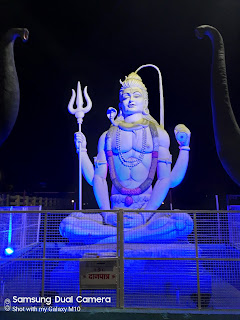
On the day of Mahashivratri, I thought to write about Adideva, the oldest diety. The earliest evidence of Lord Shiva is found in the form of 'Pashupati seal of Mohenjo-daro.' Lord Shiva Excavation of Pashupati Seal- This seal was found during 1928-29 in Block 1, southern portion of the DK-G area of Mohenjo-daro, near the famous great bath. Mohenjo-daro is a well known center of Indus valley civilization. The seal was numbered 420 by Ernest J. H. Mackey and dated it around 2350-2000 BCE, the intermediate period of Indus valley civilization. At present time this seal can be seen at National Museum, New Delhi.  Image courtesy: Wikipedia Features of Pashupati seal- The size of the seal is 3.56 cm× 3.53 cm× 0.76 cm and is made of steatite (soapstone), a magnesium rich mineral talk, which is decay resistant and soft to carve. To make the stone seals, the stone was sawed and shaped with knives, and then carved using fine chisels and drills. After that t...

Introduction to Vedic Period

Image
Vedic  period is the period in Indian  subcontinent between end of Indus valley civilization and the beginning of Buddhism and Jainism. This period  falls around between 15 th century BC to 5 th century BC. This period corresponds to bronze-iron age of northern India. Rigveda is the main textual evidence of this period, which was composed around between 15 th to 12 th century BC by Aryans. Archeological evidences of this period are not much and we shall discuss about it later. Yagna: religious act Vedic period Image courtesy: Pinterest The knowledge about this period comes from Rigvedic texts and few archaeological evidences. The Rigveda mainly consists of prayer to gods and Indra was the chief among them. Other deities were Agni, Soma, Ishwara, Ashwin, Varun, Marut etc. We shall discuss later about Rigvedic deities. As we know that there are two hypotheses about origin of Aryans, ‘migration into India’ hypothesis and ‘indigenous A...