Posts

Showing posts with the label Indus valley civilization

Historical Significance of Cremation Process

Image
At the time of Corona virus outbreak, the world has known the importance of cremation. According to WHO guidelines, cremation is the best method for disposing the dead bodies during an epidemic. What is cremation- Cremation is the method of disposing the dead body through burning or combustion. The process of cremation Image courtesy: Wikipedia  After cremation about two and half kilograms remains is produced, known as 'ashes' and consists of unburned fragments of bones. They do not constitute risk to health and may be buried, scattered in fields and water bodies or disposed in various ways. In India, there is a vast practice of ashes disposal in holy rivers at Haridwar, Prayagraj, Varanasi, Gaya etc. Cremation at Manikarnika ghat, Varanasi  Image courtesy: Wikipedia  History of cremation- The earliest archeological evidence of cremation in the world was found in Australia at lake Mungo. (ref- Bowler, J. M. 1971. Pleistocene salinities an...

History of Making Bricks in India

Image
Today, the bricks play an important role in the construction of buildings and the process of construction is called 'brick masonry.' In India, history of  the masonry is very old. The brick masonry is being practiced since the ancient times and can be traced back to the great cities of the Harappan period. Type of bricks in ancient India- In the early Harappan period, unburnt and irregular bricks were used for construction of single storey houses. The people of that period did not know the use of moulds. In the mature Harappan period, burnt bricks were used. The moulds were used to make uniform cuboid bricks. The earliest evidence of moulded bricks was found in Nal region of Balochistan dated around 30th century BC. According to Gurdeep Singh, modern Sindh and Rajasthan had dense forests during Harappan period which provided wood for brick baking.  (ref- Shreen Ratnagagar (2001), Understanding Harappan civilization in the Greater Indus Valley, p. 24) Siz...

Historicity and Location of The Rigvedic Saraswati River

Image
There is a strong query in the minds of many Indian people about the existence and location the river "Saraswati." The Saraswati is one of the main rivers mentioned in the Rigveda, an ancient Indian text. It has played an important role during  the Vedic civilization. अम्बितमे नदीतमे देवितमे सरस्वति। अप्रशस्ता इव स्मसि प्रशस्तिमम्ब नस्कृधि।। Rigveda- 2:41:16 O mother Saraswati, you are the best among all the rivers, mothers and goddesses. We are like foolish people, grant us the greatest knowledge.  Saraswati: The Goddess of Knowledge- Today, Indian people know "Saraswati" as goddess of knowledge, wisdom, art and literature. But it is originally personification of river goddess Saraswati. During the Vedic period, the earlier centers of knowledge (old schools of Vedas) might be situated at the bank of the river Saraswati. Vedic literature was supposed to have been composed by the vedic seers at its bank. Later the river goddess would have  been p...

History of Applying Sindoor on Forehead by Indian Women

Image
Sindoor (vermilion) is a red, orange or ochre colored cosmetic powder used by mainly married women of Indian subcontinent. It is made from cinnabar (a naturally occurring form of mercury sulfide), turmeric and lime.  Image courtesy: Flickr Significance of Applying Sindoor by Indian Women- Image courtesy: Flickr Sindoor has a lot of importance in Indian culture. There is a tradition of applying sindoor on parting of hairs by married Hindu women. It is considered very auspicious and applied for long life of their husbands. Traditionally, the unmarried women and widows do not apply sindoor. A woman's  bindi may also be made from sindoor.  Mythology- Sindoor is symbolized as energy of goddess Parwati, the wife of god Shiva. The Indian women believe that the goddess Parwati protects all those men whose wives apply sindoor on their forehead.  Historicity of Applying Sindoor as Cosmetic- The practice of cosmetics is believed to have or...

Pashupati of Mohenjo-daro: A Seal of Indus Valley Civilization

Image
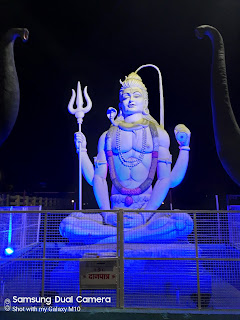
On the day of Mahashivratri, I thought to write about Adideva, the oldest diety. The earliest evidence of Lord Shiva is found in the form of 'Pashupati seal of Mohenjo-daro.' Lord Shiva Excavation of Pashupati Seal- This seal was found during 1928-29 in Block 1, southern portion of the DK-G area of Mohenjo-daro, near the famous great bath. Mohenjo-daro is a well known center of Indus valley civilization. The seal was numbered 420 by Ernest J. H. Mackey and dated it around 2350-2000 BCE, the intermediate period of Indus valley civilization. At present time this seal can be seen at National Museum, New Delhi.  Image courtesy: Wikipedia Features of Pashupati seal- The size of the seal is 3.56 cm× 3.53 cm× 0.76 cm and is made of steatite (soapstone), a magnesium rich mineral talk, which is decay resistant and soft to carve. To make the stone seals, the stone was sawed and shaped with knives, and then carved using fine chisels and drills. After that t...

The Ancient Indian War Chariot

Image
In October 2019, an article was published in  Open magazine by Nanditha Krishna a historian at CPR Institute of Indological Research in Chennai. She claimed that she got knowledge about an ancient clay tablet from Nepal through an  email from her friend. Her friend Jeremy Pine is a terracotta dealer in Hong Kong and brought that tablet from Nepal. Image courtesy: Open magazine         The  thermoluminescene test of this tablet was done by Oxford Authentication on 14th May 2019 and dated the firing of the tablet between 1600 BC- 300BC. Image courtesy: Open magazine          Now we focus some important signs of this tablet:- The hairstyle or headdress that resembles that of Indus valley civilization. Chariot is being pulled by four Horses . The spoked wheels of the chariot. Absence of any Indus language sign The ancient Indian chariots- The chariot...